

The Department of Municipalities and Transport (DMT) has launched two advanced digital planning technologies, highlighting how data-led tools are helping to shape more liveable, connected, and responsive communities across the emirate.
The technologies reflect how DMT is bringing more intelligence into the planning process. By connecting data, systems and design tools, decisions can be made earlier, with greater clarity and a stronger focus on liveability. They also show how digital transformation can support faster services, better coordination and places designed around how people live, move and use the city.
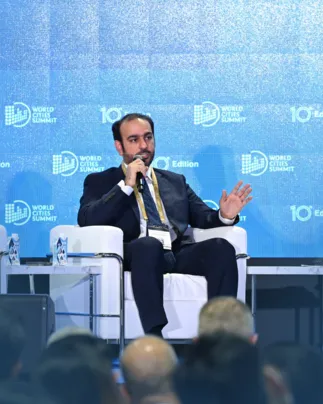
His Excellency Abdulla Mohamed Al Blooshi, Director General of the Urban Planning and Permits Centre at DMT, said: “The technologies reflect how DMT is strengthening the way Abu Dhabi is being planned, managed and experienced. These advanced technologies give us a clearer view of the city, help us simulate planning scenarios earlier and support faster decision-making, more joined-up services for residents, businesses and government partners.
“For DMT, digital transformation is not only about systems, it is about creating the conditions for better places, stronger communities and a more liveable Abu Dhabi.”
The Nabd platform brings together data from across DMT’s systems, sensors and infrastructure into a single digital model of the emirate. It provides decision-makers with a live three-dimensional view of Abu Dhabi, including buildings, roads, utilities, underground infrastructure and other key urban assets.
Rather than relying on separate systems or static information, Nabd provides DMT with a more complete understanding of how the city is functioning. This supports faster coordination between teams, improves visibility across planning and service delivery, and helps identify where action may be needed.
Through Nabd, DMT can bring together real-time city modelling, operational data from over 70 data sources, linked to more than 15 connected systems, planning analytics and liveability indicators in one place. This gives teams a clearer basis for decisions on infrastructure, services and future development, while helping to identify issues and opportunities earlier.
The platform also includes a liveability dashboard, providing neighbourhood-level insights across the emirate. By bringing together indicators such as service accessibility, infrastructure availability and community facilities, DMT can better understand where communities are well-served, where further investment may be required, and how future development can better respond to changing needs.
Phase one of Nabd is expected to go live in early 2027, with further capabilities to follow. At ADIS 2026, visitors witnessed the foundation of a system designed to support more responsive, evidence-led planning across Abu Dhabi.
While Nabd provides a live view of how the emirate functions, Our Holographic Future, the Real-time 3D Hologram System helps planners look ahead, testing how future places could work before they are built.
The system uses third-party technology to help urban designers, planners and decision-makers visualise future development scenarios before construction begins.
The technology allows planners to assess more than the appearance of buildings. It can show how streets may feel at pedestrian level, how people may move through public spaces, how shade and sightlines work, and how building heights, frontages, public realm and green spaces interact.
This gives DMT a more effective way to test design options early, compare different approaches and refine plans before they are delivered. It also supports a more human-centred planning process, where the everyday experience of residents, visitors and businesses is considered from the beginning.
Alongside its digital planning tools and smart solutions, DMT is also highlighting infrastructure projects that demonstrate how integrated planning is translated into delivery across Abu Dhabi. These projects show how technology, urban planning and investment work together to improve connectivity and support more liveable communities.
One of these projects, valued at AED450 million, includes two new marine bridges linking Al Reem Island with Sheikh Khalifa Bin Zayed Highway. Designed to accommodate up to 7,200 vehicles per hour, the project is expected to reduce peak-hour travel times by up to 60 per cent, saving commuters up to 15 minutes. It will also improve access between Al Reem Island, Saadiyat Island and key highway routes.
The project also includes two kilometres of pedestrian and cycling tracks, landscaped spaces and smart lighting, demonstrating how major infrastructure can support movement, accessibility and quality of life.
As DMT continues to expand the use of digital planning tools, the aim is to support more efficient approvals, stronger service delivery and better-connected communities across the emirate.