

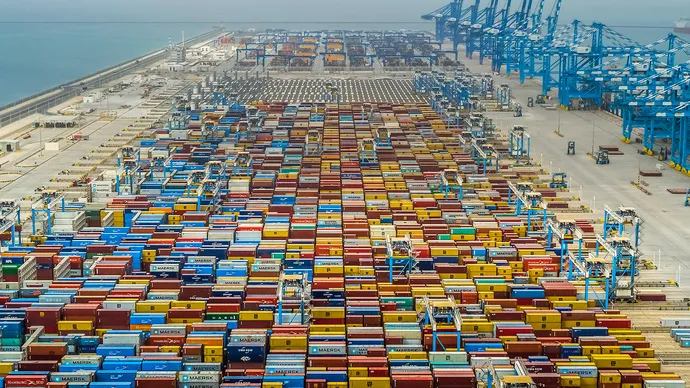
Abu Dhabi's distribution and re-export activities are supported by an integrated network of ports, industrial and logistics zones, warehousing facilities and transport connections. According to Abu Dhabi Customs, the emirate's non-oil foreign trade reached AED415.4 billion in 2025, an increase of 36 per cent year on year.
Non-oil exports rose by 63 per cent to AED175.4 billion, imports increased by 22 per cent to AED170.4 billion, and re-exports grew by 20 per cent to AED70 billion. These figures provide an indication of the scale and growth of trade activity supported by the emirate's logistics infrastructure.
Transport and connectivity
According to KEZAD Group, Khalifa Port is served by 25 major shipping lines with links to more than 90 international destinations, and KEZAD was the first port and economic zone in the UAE to be connected to the Etihad Rail network. More than 75 per cent of the UAE’s urban areas are within a 90-minute drive of its zones.
In May 2026, AD Ports Group announced a multimodal inland logistics network connecting Khalifa Port and Fujairah Terminals with rail-linked dry ports and cargo depots, including Industry City of Abu Dhabi (ICAD), which is operated by KEZAD Group. The network is intended to strengthen the use of the UAE’s national rail infrastructure for industrial cargo.
Data from Abu Dhabi Customs shows that land transport accounted for 35 per cent of the emirate’s non-oil trade in 2025, air for 33.5 per cent and sea for 31.5 per cent.
Space and facilities
According to KEZAD Group, part of AD Ports Group, Khalifa Economic Zones Abu Dhabi (KEZAD) covers more than 550 square kilometres, including 100 square kilometres of free zone, and accounts for 55 per cent of the UAE’s industrial area.
According to KEZAD Group, its zones include more than 540,000 square metres of warehouse space. Facilities include serviced industrial and logistics plots, pre-built warehouses, light industrial units, cold-store convertible warehouses and build-to-suit developments.
KEZAD operates under two jurisdictions. In the free zone, companies may be wholly foreign-owned, may repatriate all capital and profits and pay no customs duties on goods within the zone, with standard duties applying to goods sold into the local market.
Businesses operating in KEZAD's domestic economic zone may be eligible for UAE origin certification and preferential customs treatment within GCC markets, subject to applicable rules of origin and regulatory requirements. According to KEZAD Group, the two jurisdictions together offer more than 1,100 permitted activities.
Land rates
KEZAD Group’s published tariff sets annual rates of AED32–38 per square metre for serviced industrial plots and AED36–45 per square metre for serviced logistics plots in Abu Dhabi, with a common area maintenance charge of AED3 per square metre per year.
These published rates relate to serviced land and do not represent the total cost of establishing or operating a distribution facility.
Industrial and procurement activity
The UAE's expanding industrial activity also provides a wider context for logistics and distribution services, particularly those supporting manufacturers, suppliers and industrial supply chains.
At national level, the UAE’s industrial exports reached AED262 billion in 2025, an increase of 25 per cent on 2024, according to figures announced by the Ministry of Industry and Advanced Technology and reported by the Emirates News Agency (WAM). Exports from medium- and high-technology industries reached AED92 billion, up 42 per cent year on year.
At the fifth edition of Make it in the Emirates in Abu Dhabi on 4 May 2026, His Excellency Dr Sultan Ahmed Al Jaber, Minister of Industry and Advanced Technology, announced that industrial procurement opportunities had been raised from AED168 billion to AED180 billion over the coming decade, with more than 5,000 products targeted for localisation.
Abu Dhabi's port infrastructure, industrial and logistics facilities, and expanding multimodal transport connections provide businesses with options for establishing and developing distribution and re-export operations. Together with the emirate's growing non-oil trade activity, these capabilities support its continued development as a regional logistics and trading centre.
