
Environment Agency - Abu Dhabi (EAD) has completed a landmark multi-year oyster bed mapping survey, delivering the most comprehensive scientific understanding to date of oyster bed distribution across the emirate’s marine waters.
With survey design established in 2022 and fieldwork carried out from 2023 to the end of 2025, the project reflects EAD’s continued commitment to advancing science-led environmental governance and strengthening Abu Dhabi’s position as a leader in marine environmental governance in the region. By combining historical knowledge with advanced scientific methodologies, the initiative has established a robust baseline for one of the UAE’s most culturally and ecologically significant marine habitats.
This project was developed following EAD’s prior deep-water survey (2021), which identified marine areas of significant ecological potential and, in doing so, revealed the unexpected presence of oyster beds across Abu Dhabi’s waters. Building on those findings, EAD designed a dedicated oyster bed survey in 2022 to systematically map these habitats at scale.
The survey drew on five data sources established during the 2022 design phase: findings from the 2021 Deep Water Survey; historical pearl diver maps from the 1960s and 1970s; Hawksbill turtle tracking data, as these endangered turtles are known to congregate around oyster beds, making them a natural indicator of habitat presence; oyster rehabilitation sites; and knowledge gathered from experienced local community members.
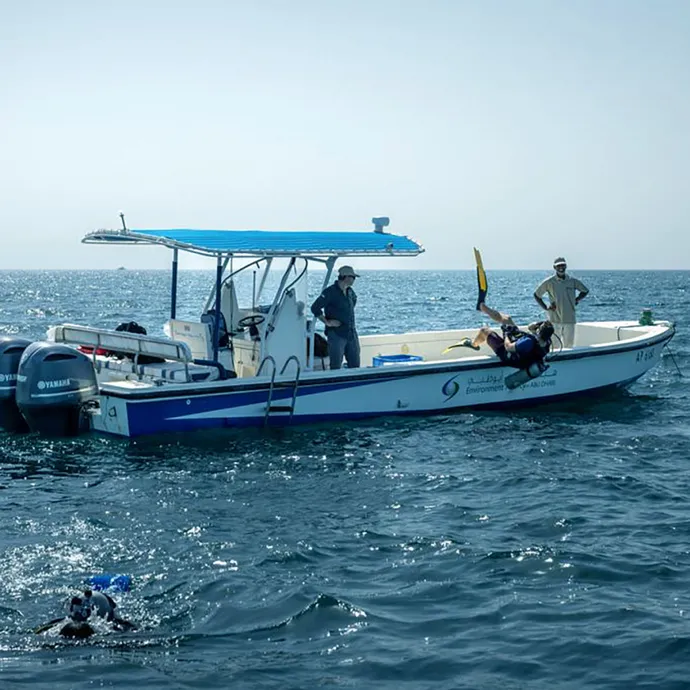
From 335 initial target points, field teams expanded outward in all directions until oyster presence could no longer be confirmed, using underwater drop cameras and a real-time mobile data collection application connected directly to EAD’s database. This approach ensured that the boundaries of every oyster bed were systematically defined rather than assumed, producing what is now the most rigorously validated map of oyster bed distribution in the region.
Building on generations of local knowledge, the project also drew on the maritime heritage of Abu Dhabi’s coastal communities. Historical maps drawn from pearl divers’ firsthand knowledge were overlaid with modern survey data, satellite tracking, and field observations. This bridged centuries of inherited understanding with cutting-edge science. EAD’s latest findings confirm that oyster beds are far more extensive than previously recorded.
Through an extensive field survey covering approximately 12,000 kilometres, EAD assessed 1,088 locations across Abu Dhabi’s waters, of which 334 confirmed the presence of oyster bed. Together, these sites cover a total area of approximately 3,314 square kilometres, equivalent to around 7 per cent of the emirate’s marine environment.
Her Excellency Dr Shaikha Salem Al Dhaheri, Secretary General of the Environment Agency - Abu Dhabi, said: “This milestone reflects Abu Dhabi’s deep-rooted connection to its marine environment, shaped over generations through one of the world's greatest pearling traditions, a heritage that placed these very waters at the centre of regional trade and identity for centuries. Guided by the vision of the late Sheikh Zayed bin Sultan Al Nahyan, we continue to build on this legacy through a science-led approach that strengthens our understanding of the emirate’s natural assets. These findings highlight the richness of our marine ecosystems and reinforce our responsibility to protect and sustain them for future generations, in line with Abu Dhabi’s commitment to Net Zero by 2050.”
Oyster beds play a vital role in supporting marine biodiversity, providing habitat and feeding grounds for a wide range of species across the marine food chain. As natural ecosystem engineers, oysters contribute to the overall health and resilience of marine environments. EAD teams observed a direct correlation between oyster bed locations and large concentrations of fish, as well as whale sightings in surrounding waters, confirming their role as a keystone habitat anchoring the wider marine ecosystem.
Beyond their ecological function, oysters are significant contributors to carbon storage. As oysters grow, they draw dissolved carbon from the surrounding seawater to produce calcium carbonate, the mineral that forms their shells. This biological process effectively binds carbon within marine systems over time, giving oyster beds an important role in the UAE’s broader environmental ambitions and its pathway to Net Zero by 2050.
For generations, coastal communities in Abu Dhabi have understood these waters in a deeply intuitive way, developing knowledge of where oyster beds exist and how marine life interacts with them. This project has built on that foundation and validated it at scale through scientific methods. By combining field surveys with advanced data analysis, EAD has confirmed not only the presence of these habitats, but their true extent and density across Abu Dhabi’s waters, affirming just how rich and interconnected these marine ecosystems are.
These findings establish a critical scientific baseline for the long-term management and protection of Abu Dhabi’s marine environment. Looking ahead, EAD will advance targeted monitoring programmes, pursue the designation of new marine protected areas based on the survey’s findings, and ensure these critical habitats are safeguarded for generations to come. As the emirate continues to deepen its understanding of its marine ecosystems, this project stands as a testament to what becomes possible when traditional knowledge, scientific rigour, and long-term commitment come together.