
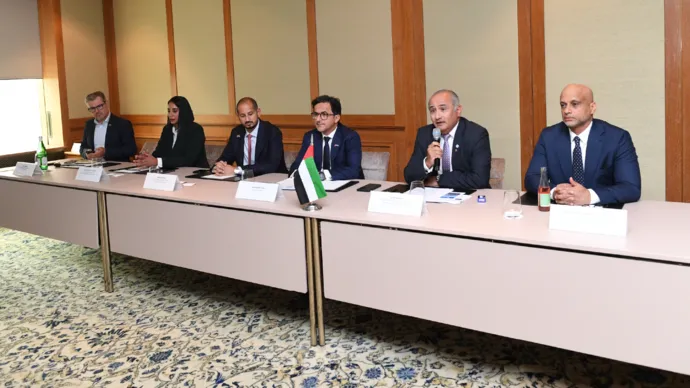
The Abu Dhabi Chamber of Commerce and Industry (ADCCI), in cooperation with the Germany-UAE Business Council (GUBC), convened a closed-door roundtable bringing together the manufacturing sectors of Abu Dhabi and Berlin in the German capital, Berlin.
The roundtable aimed to strengthen industrial cooperation, identify practical pathways for industrial partnerships and investments, localise technology, develop supply chains, and support the growth of manufacturing companies in global markets. It brought together leading manufacturers and investors, as well as representatives of government and economic entities and institutions from both sides.
The roundtable took place amid the growing presence of the German business community in Abu Dhabi. Between 2024 and 2025, the number of German companies registered with Abu Dhabi Chamber increased by 10.6 per cent. Foreign company branches grew by 14 per cent, while companies with German partners increased by 10.1 per cent over the same period. These indicators reflect an expanding base of shared commercial interests and reinforce Abu Dhabi Chamber's efforts to translate the complementarity between German industrial capabilities and Abu Dhabi's competitive advantages into joint projects and scalable opportunities.
The event brought together decision-makers from major industrial, energy, engineering and advanced-technology organisations, enabling direct exchange on commercially viable opportunities and the capabilities required to move them towards implementation.
The dialogue centred on five priority sectors where Abu Dhabi's industrial objectives align closely with Germany's technological and manufacturing strengths: smart manufacturing, clean technology, advanced materials, mobility, and medical technology. These focus areas support Abu Dhabi's vision for a smart and sustainable industrial economy and contribute to the Abu Dhabi Industrial Strategy's target of increasing the manufacturing sector's contribution to AED172 billion by 2031. They also align with the UAE's Operation 300bn and Make it in the Emirates initiatives, which support industrial growth, advanced-technology adoption, supply-chain resilience, and global competitiveness.
The Abu Dhabi delegation was led by His Excellency Amer Fayez Kakish, Board Member of Abu Dhabi Chamber and CEO of Ittihad International Investment, alongside Musabbeh Al Kaabi, Co-Chair of the Germany-UAE Business Council representing the UAE side. Participants included Her Excellency Marwa Al Mansoori, Board Member of Abu Dhabi Chamber; His Excellency Khalid Bin Hadi, Board Member of the Chamber and CEO of Siemens Energy UAE; Eng Anas Aljuaidi, CEO of Mannesmann Energy; and other representatives of Abu Dhabi’s industrial and business sectors.
The German delegation included Armin Peter, Managing Director of the German-UAE Business Council; Helmut von Struve, CEO of Siemens in the Middle East; Thomas Herrmann, Chief Strategy Officer at Evonik Industries AG, a global leader in specialty chemicals; Fatemah Din, Senior Vice President, MENA, at thyssenkrupp Uhde, which specialises in industrial engineering and sustainable chemical solutions; and Holger Schäfer, Head of Government Affairs at German energy company EnBW. Their participation underscored the roundtable's importance as a direct platform connecting advanced German capabilities with Abu Dhabi's investment, manufacturing, and growth opportunities.
HE Amer Fayez Kakish, Board Member of the Abu Dhabi Chamber of Commerce and Industry, said: “This roundtable marks a practical step towards building long-term industrial partnerships that combine German engineering and technological expertise with Abu Dhabi’s advanced industrial ecosystem. We aim to translate this dialogue into implementable projects in co-manufacturing, technology localisation and supply-chain development, while strengthening Abu Dhabi’s position as a base for German companies to grow and reach regional and global markets. The value of these meetings will be measured by the lasting business relationships, investments and opportunities they create.”
HE Marwa Al Mansoori, Board Member of Abu Dhabi Chamber, said: “Abu Dhabi Chamber continues to empower the business community by translating economic engagement into practical opportunities for the private sector. This roundtable creates a direct pathway connecting manufacturers, investors, and technology leaders to identify partners, localise advanced capabilities and develop commercially viable projects. Abu Dhabi’s integrated ecosystem — comprising advanced infrastructure, specialised economic zones, reliable energy, and global connectivity — provides companies with a strong platform to scale and build sustainable industrial cooperation between the Emirati and German business communities.”
According to Germany’s Federal Statistical Office, manufacturing accounted for 19.9 per cent of the country’s total gross value added in 2024. The Office’s industry dashboard also reports total sales of approximately €2.1 trillion and around 7.5 million people employed in the sector.
Abu Dhabi's industrial sector continues to demonstrate its capacity to support international partnerships. Manufacturing generated AED30.5 billion in value added during the third quarter of 2025, accounting for 9.4 per cent of the emirate's GDP. Industrial activity also expanded, with 115 new facilities reaching full production in 2025, compared with 75 facilities in 2024.
Participants also discussed the role of Khalifa Economic Zones Abu Dhabi (KEZAD Group) including Industrial City of Abu Dhabi (ICAD 1) in supporting industrial growth and investment. KEZAD Group spans 550 square kilometres, with industrial and manufacturing activities accounting for 67 per cent of leased land, while ICAD 1 operates at full capacity, reflecting strong demand for specialised industrial infrastructure.
The roundtable provided a platform to identify investment and partnership opportunities, facilitate targeted technical and commercial discussions, and assess potential pilot projects, joint manufacturing initiatives, local assembly, and technology-transfer opportunities. It concluded with a commitment to maintain engagement among participating organisations and advance commercially viable partnerships across priority industrial sectors, strengthening long-term manufacturing cooperation between Abu Dhabi and Germany.