

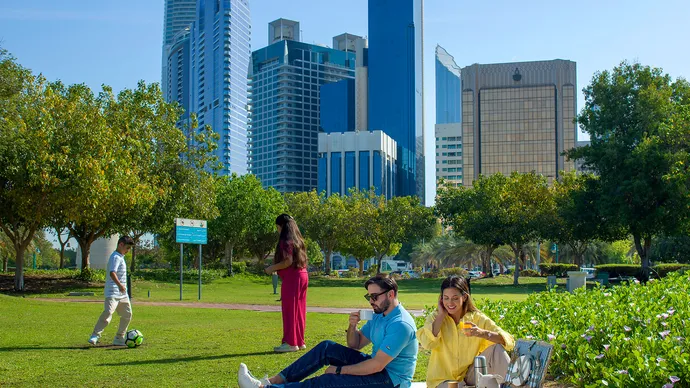
Abu Dhabi Government entities continue to launch and develop projects and initiatives designed to improve quality of life – for both citizens and residents – across the emirate, supporting a cohesive society and way of life that is reliably safe and secure.
The Department of Community Development (DCD) has recorded an increase in satisfaction with family life to 78.4 per cent in the sixth cycle of its Quality of Life Survey, launched in 2025 with 115,801 citizens and residents of Abu Dhabi. The results reflect the emirate’s focus on community wellbeing and its position as the highest-ranked city in the Middle East and North Africa on the Global Liveability Index 2026, released by the Economist Intelligence Unit (EIU) on 7 July 2026.
The survey also showed that 94.1 per cent of participants feel safe walking at night. Satisfaction with social relationships reached 75.8 per cent and housing satisfaction 71.5 per cent, while satisfaction with work–life balance rose from 46.8 per cent to 51.1 per cent and the average happiness score reached 7.88 out of 10.
Global liveability
The Global Liveability Index 2026 ranked the emirate 76th among 173 cities worldwide and first in the Middle East and North Africa. The index assesses 30 indicators across five categories: stability, healthcare, culture and environment, education and infrastructure.
Healthcare
In April 2026, the Department of Health – Abu Dhabi (DoH), in collaboration with SEHA Clinics, a subsidiary of PureHealth, extended 24-hour operations to 12 primary care centres in Abu Dhabi and Al Ain, with urgent care services at selected locations. The centres provide chronic and acute disease management, vaccination, health education, mental health support and specialist coordination.
DoH’s designated Centres of Excellence have provided specialised care for more than 3,000 complex cases since their launch in 2023, enabling 1,664 families to access specialised care in the emirate and contributing to a 60 per cent reduction in the need for treatment abroad. Their specialties include adult and paediatric cardiovascular care, stroke treatment, burn care, haematopoietic stem cell transplantation, and adult multi-organ transplantation.
Schooling
According to the Abu Dhabi Department of Education and Knowledge (ADEK), the emirate had 220 private schools and 233 nurseries across Abu Dhabi, Al Ain and Al Dhafra as of October 2025, offering a range of curricula. Two new private schools added 3,610 seats and seven new nurseries added 929 seats.
Under ADEK’s School Fees Policy, schools must publish their fee payment schedules and obtain ADEK approval before increasing fees. Schools must offer tuition payment in at least three equal instalments per academic year, up to 10, and registration fees are capped at 5 per cent of ADEK-approved tuition fees.
Living costs and housing
According to the Statistics Centre – Abu Dhabi (SCAD), the emirate’s Consumer Price Index rose by 0.3 per cent in 2025, following a 0.5 per cent increase in 2024, with food and beverage prices up 0.1 per cent.
On 3 June 2026, the Abu Dhabi Real Estate Centre (ADREC) announced that Abu Dhabi Government had reduced the permitted annual rent increase from 5 per cent to 0 per cent for residential, commercial and industrial properties across the emirate, as a temporary measure until further notice. All lease renewals and new agreements reference the rent recorded in the property’s last registered Tawtheeq contract.
With high levels of safety and wellbeing, a growing education sector and stable prices, the emirate continues to enhance quality of life for citizens, residents and families.
